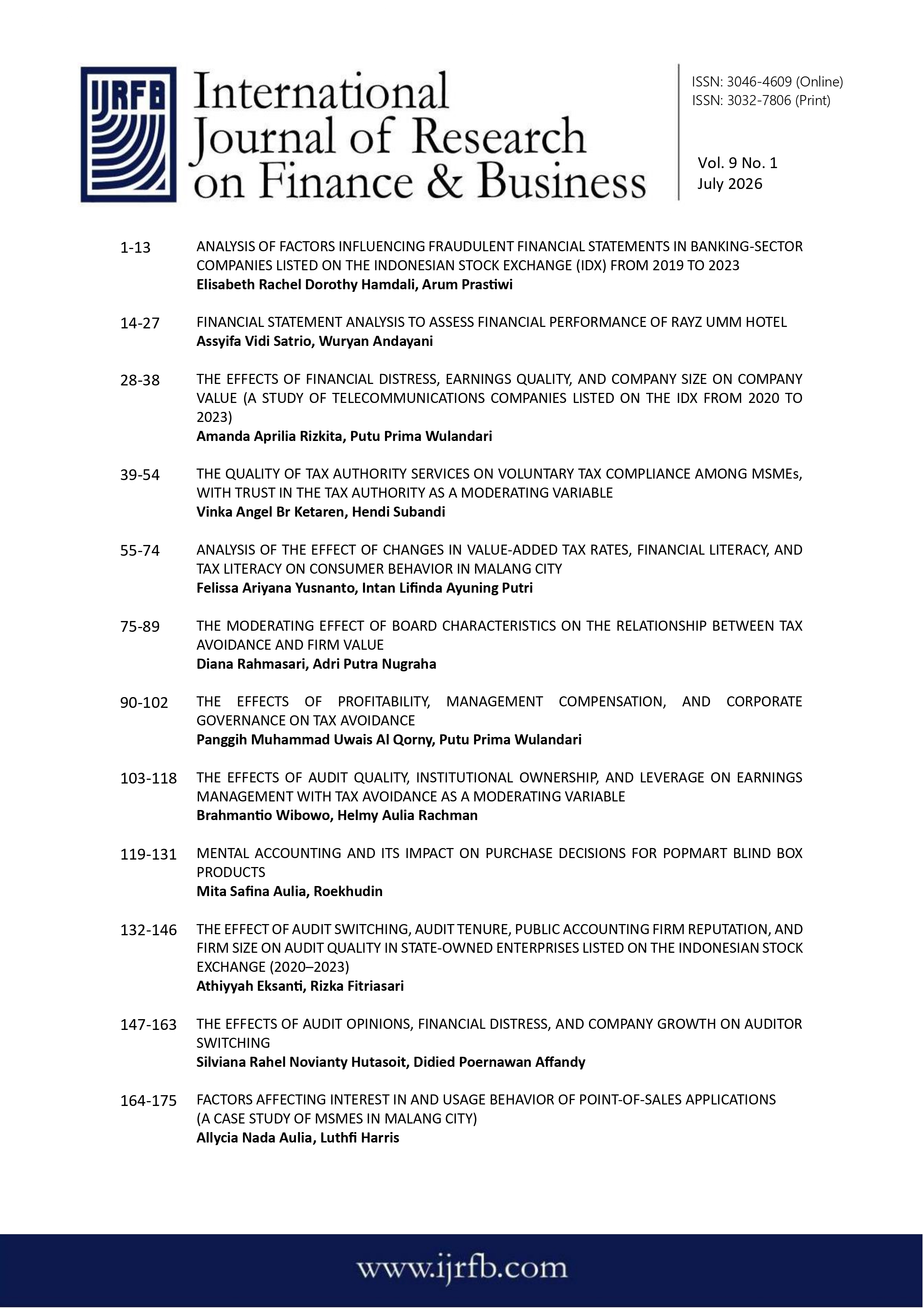
ANALYSIS OF FACTORS INFLUENCING FRAUDULENT FINANCIAL STATEMENTS IN BANKING-SECTOR COMPANIES LISTED ON THE INDONESIAN STOCK EXCHANGE (IDX) FROM 2019 TO 2023
DOI:
https://doi.org/10.70575/ijrfb.v9i1.143Keywords:
Banking Sector Companies, Fraud Hexagon Theory, Fraudulent Financial Statements, Panel DataAbstract
This study examines and analyzes the factors influencing fraudulent financial statements at 34 Indonesian banking companies during the period from 2019 to 2023, using the Fraud Hexagon theory. The rise in the number of fraud cases has made fraudulent financial statements in the banking sector a serious concern due to the vital role banks play in the national economy. A quantitative approach using panel data regression analysis was employed. The results show that external pressure has a negative impact on fraudulent financial statements, while industry characteristics have a positive impact. External pressure acts as a deterrent, as high leverage encourages management to comply with regulations and standards in order to maintain reputation, preserve market confidence, and avoid sanctions. Conversely, industry characteristics act as a driving factor, as changes in accounts receivable—often based on estimates—are susceptible to manipulation. Other variables, such as personal financial needs, ineffective oversight, auditor opinions, total accruals, board turnover, CEO education level, CEO dual leadership, number of CEO photos, state-owned enterprises, and collaboration on government projects, had no significant impact. These findings contribute to the design of fraud prevention strategies by emphasizing the importance of stricter oversight in industries vulnerable to manipulation and leveraging external pressure to enhance transparency.